

First authors: Minghao Liu, Shuai Yang
Corresponding authors: Gaofeng Zeng, Qing Xu, Chengxing Cui
Affiliations: Shanghai Advanced Research Institute, CAS; Henan Institute of Science and Technology
DOI:10.1038/s41467-023-39544-9
To design efficient catalysts for the CO₂ reduction reaction, a variety of catalytic metal centres and ligand molecules have been assembled into covalent organic frameworks (COFs). Amine ligands can strengthen the binding affinity toward CO₂ molecules, while ionic skeletons improve electronic conductivity and charge transport along the framework. Nevertheless, the direct synthesis of COFs simultaneously bearing amine ligands and ionic skeletons remains challenging due to the trade‑off between electrostatic repulsion and ligand stability.
Herein, Gaofeng Zeng, Qing Xu, Chengxing Cui and co‑workers developed COFs for CO₂ reduction. By tuning the ligands and linkages of the parent COF, they successfully established the correlation between COF structure and catalytic performance. Dual modification enables fine regulation of CO₂ binding capacity and electronic states, achieving controllable activity and selectivity for CO₂RR. Notably, this bifunctional COF delivers high selectivity, with a maximum CO Faradaic efficiency of 97.32% and a turnover frequency (TOF) as high as 9922.68 h⁻¹. Its performance outperforms the pristine COF and singly modified COFs significantly. Furthermore, theoretical calculations reveal that the enhanced catalytic activity originates from the favourable conversion of the *COOH intermediate into *CO. This work offers new insights into the rational design of COFs for CO₂ reduction.
Highlights
A hierarchical post-synthetic modification strategy was developed to construct COFs (N⁺-NH-COF) with outstanding electrocatalytic CO₂ reduction performance, where N⁺ represents ionic modification and NH refers to reductive modification.
The as-synthesized catalyst achieves a maximum CO Faradaic efficiency of 97.32% at −0.8 V, and a turnover frequency (TOF) up to 9922.68 h⁻¹ at −1.0 V vs. RHE.
Reduction of C=N coordination bonds into C–N bonds and ionic functionalization of linkers within COFs can remarkably boost catalytic activity and product selectivity.
Background
Covalent organic frameworks (COFs) are highly tailorable porous polymers composed of organic nodes and covalently linked linkers. The diversity of building blocks endows them with high structural tunability in skeletons, porosity and topologies, enabling a wide range of customizable functions. Benefiting from molecular designability, COFs serve as ideal platforms for constructing CO₂RR catalysts, and their catalytic performance is determined by their structures and intrinsic properties. Structurally, properties such as CO₂ binding affinity and electronic conductivity can be regulated by modifying building blocks or linkages. Accordingly, COFs bearing amine linkages and ionic skeletons are highly desirable for efficient CO₂RR, since amine linkages strengthen CO₂ adsorption while ionic skeletons improve framework conductivity.
The bottom-up synthetic strategy is the most common route for directly fabricating functional COFs. Nevertheless, some functional groups cannot be incorporated directly via bottom-up synthesis owing to steric hindrance, solubility differences and microscale reversibility. As an alternative approach, post-synthetic modification provides a promising route for constructing functional skeletons, pores and linkages with controllable catalytic performance at the molecular level. Therefore, COFs with reduced imine linkages and ionic skeletons can be expected if single-step reductive and ionic post-modification can be well integrated. However, relevant studies along this direction remain scarce.
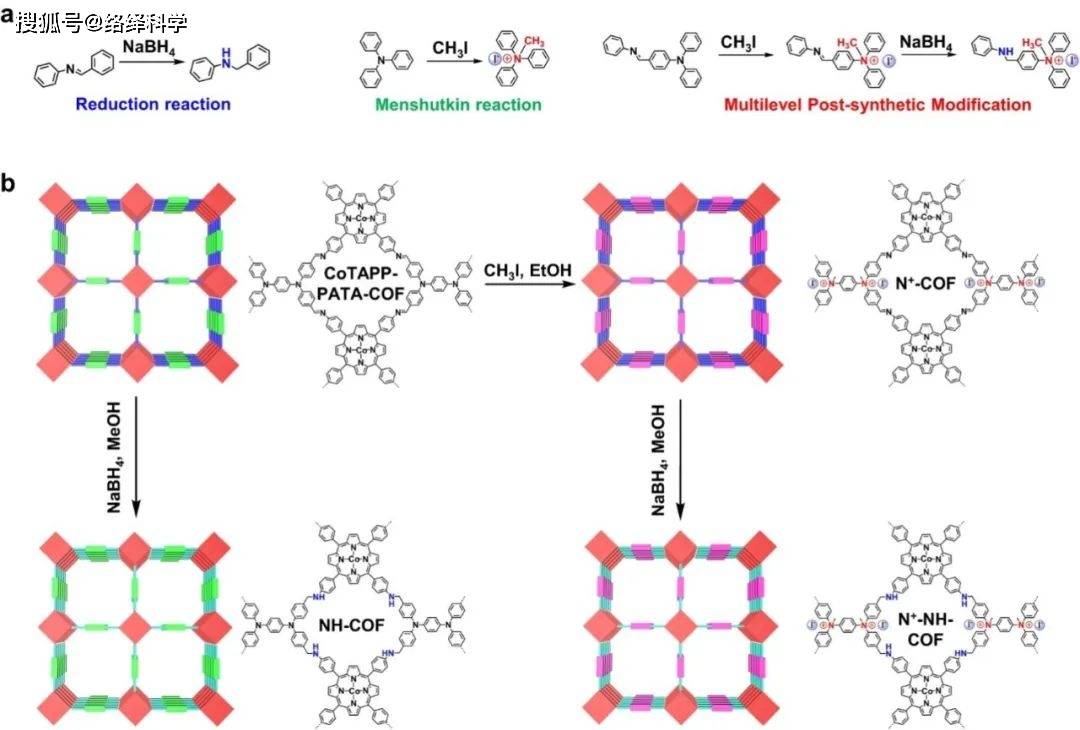
图 1. 多级合成后改性过程的示意图
The PXRD patterns of CoTAPP-PATA-COF exhibit characteristic peaks at 5.15°, 11.02°, 12.23° and 21.84°, which correspond to the (011), (022), (031) and (001) planes, respectively. Meanwhile, CoTAPP-PATA-COF adopts an AA-stacking crystal structure, offering open channels for efficient mass transport.

Figure 2. PXRD patterns of four sets of COFs (a)CoTAPP-PATA-COF,(b)NH-COF,(c)N+-COF,(d)N+-NH-COF
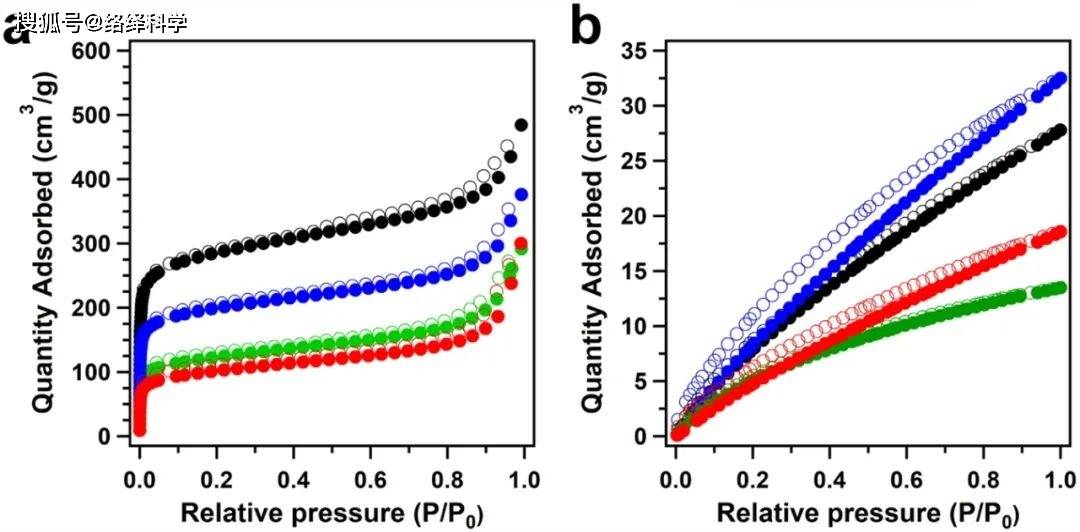
Figure 3. (a) Nitrogen adsorption-desorption isotherms at 77 K and (b) CO₂ adsorption isotherms at 273 K of CoTAPP-PATA-COF (black), N⁺-COF (green), NH-COF (blue) and N⁺-NH-COF (red)
The Co contents in CoTAPP-PATA-COF, N⁺-COF, NH-COF and N⁺-NH-COF are 4.0, 4.0, 3.7 and 3.7 wt.%, respectively, which are consistent with the ICP results (3.6, 3.5, 3.3 and 3.1 wt.%, respectively). In addition, the high-resolution C 2p XPS spectra of the four COFs all reveal Co-N coordination, confirming that the Co-N active sites are well preserved after hierarchical modification.

Figure 4. Electronic structure characterizations of four COFs
The LSV curves show that CoTAPP-PATA-COF and NH-COF deliver similar current densities within the same potential window. In contrast, N⁺-COF and N⁺-NH-COF exhibit enhanced current densities, indicating that ionic skeletons facilitate electron transport and thereby raise current output. The TOF values of CoTAPP-PATA-COF, N⁺-COF, NH-COF and N⁺-NH-COF at −1.0 V are 4166.19, 7453.19, 7604.63 and 9922.68 h⁻¹, respectively.

图 5. COFs 的电催化 CO₂ 还原性能
From a thermodynamic perspective, the lowest Gibbs free energy change for *COOH on M-I-N⁺-NH-COF is consistent with its optimal catalytic performance. In addition, the Gibbs free energy change (ΔG) of *COOH for M-I-N⁺-COF and M-I-N⁺-NH-COF are both lower than those of M-CoTAPP-PATA-COF and M-NH-COF, demonstrating that the promotional effect of the ionic modification is superior to that of the neutral one.