

Chinese Battery Enterprises Go Global, Turning a Country Smaller than Zhejiang into the World’s Second-Largest Power Battery Producer
June 30, 2023, 22:29http://m.caijing.com.cn/article/304166?target=blank
By: Jingyi Wang, Caijing Journalist Edited by: Zhiliang Shi
When major Chinese battery firms such as CATL make investments, a city or even an entire country can build a battery industry from scratch.
China is the world’s largest producer of power batteries. Which country will take second place in the future?
Contrary to many expectations, it is neither Germany nor the United States, but Hungary, a Central‑European nation.
Hungary has a population of less than 10 million, comparable to that of a second‑tier Chinese city. Its land area is 93 000 km², slightly smaller than China’s Zhejiang Province (101 800 km²).
The automotive sector serves as Hungary’s economic pillar. Mercedes‑Benz, BMW and Audi all run electric‑vehicle businesses here. Chinese battery enterprises, acting as battery suppliers, have also set up local operations in Hungary.
At the World New Energy Vehicle Power Battery Conference held in Yibin on June 9, Péter Szijjártó, Minister of Foreign Affairs and Trade of Hungary, stated in his speech that thanks to a string of investments from Chinese enterprises, Hungary’s power‑battery output now ranks fourth globally and will soon rise to second place worldwide, only trailing China
On June 8, EVE Energy (300014.SZ), a Chinese battery manufacturer, announced plans to build a plant in Debrecen, Hungary, with an investment of EUR 1.31 billion (approximately RMB 9.97 billion). The Hungarian facility will produce large‑format cylindrical batteries to supply BMW locallyDebrecen.
One year earlier, Contemporary Amperex Technology Co., Limited (CATL, 300750.SZ) delivered Hungary’s‑largest‑ever investment project. In August 2022, CATL announced the phased construction of a battery plant in Debrecen with a total investment of no more than EUR 7.34 billion (around RMB 56.37 billion) and a planned total capacity of 100 GWh, serving clients including Mercedes‑Benz, BMW and Volkswagen
Driven by investments from Chinese battery firms, China is expected to once again become Hungary’s largest source of foreign investment in 2023. Debrecen, a city with a population of fewer than 200 000, has evolved into a power‑battery industrial hub for Hungary and even for the whole of Europe.
Fourth today, soon‑to‑be‑second in the world
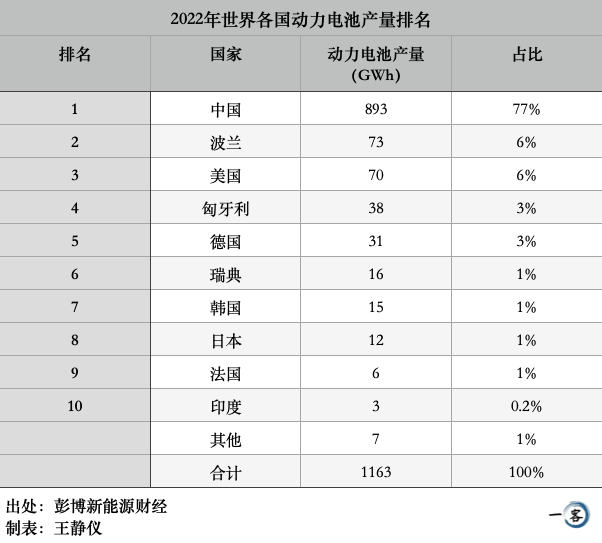
According to data from BloombergNEF, China topped the global battery‑capacity ranking in 2022 at 893 GWh, accounting for 77 % of global capacity. Poland and the United States took second and third spots with 73 GWh and 70 GWh respectively, each holding a 6 % global share. Hungary ranked fourth at 38 GWh, representing 3 % of worldwide capacity.
Why Hungary? The shift is mainly fuelled by the electrification drive of multinational carmakers, especially German OEMs.
Mercedes‑Benz and BMW have constructed electric‑vehicle factories in Hungary, while Audi has launched electric‑motor production at its Hungarian site. “Only three countries in the world — Hungary, China and Germany — host manufacturing plants for all three top‑tier luxury automotive brands,” noted Szijjártó
To meet procurement requirements from multinational automakers, Chinese battery suppliers have flocked to Hungary to set‑up local production.
CATL’s project stands out for its scale. In 2022 CATL announced its second European battery factory in Hungary with a capacity of 100 GWh — seven times the 14 GWh capacity of its first European plant in Germany. It is projected to create 9 000 new local jobs and supply Mercedes‑Benz, BMW and Volkswagen.
From CATL’s perspective, Hungary boasts three major strengths. First, it has a long‑standing automotive‑manufacturing heritage, complete industrial support chains and abundant raw‑material resources in surrounding regions. Second, its geographically‑central European location hosts a large cluster of vehicle OEMs; local manufacturing enables timely responses to customer demands. Third, Hungary, and Debrecen in particular, offers a favourable investment climate with sound infrastructure and talent pools.
EVE Energy also selected Debrecen. In June 2023, the firm announced a EUR 1.31 billion (roughly RMB 9.97 billion) investment to manufacture large‑cylindrical batteries for BMW.
Previously, Semcorp (002812.SZ) invested EUR 340 million in 2021 to build a lithium‑battery‑separator production base in Debrecen, which was undergoing pre‑commissioning preparations. In 2022, NIO constructed its first‑ever overseas facility in Debrecen, functioning as NIO’s European manufacturing, service and R&D centre for its battery‑swap products.
Given the large number of ongoing projects, Szijjártó commented that Hungary currently ranks fourth globally for power‑battery output and will climb to second position once all invested projects reach full capacity.
Notably, nearly all these investments converge in Debrecen. Though little‑known in China and home to merely 200 000 residents, the arrival of CATL and EVE Energy has attracted upstream‑supply‑chain enterprises and generated clear battery‑industry‑cluster effects.
Szijjártó disclosed that another top‑10 global power‑battery manufacturer would soon announce a Hungarian‑investment proposal. The country aims to build a large‑scale European‑battery‑production cluster supplying automotive batteries across Europe and globally.
Chinese battery firms: Hungary’s top source of foreign capital
Over the preceding eighteen months, power batteries became Hungary’s leading export commodity, lifting Hungary to the world’s 34th‑largest exporter by value in 2022, even though Hungary ranks 95th globally by population.
“The electric‑vehicle sector constitutes a genuine meeting‑point between Eastern and‑Western economies. Major Western automakers are rapidly pivoting toward EVs. At present, battery‑production is dominated by China and South Korea. This demonstrates Hungary’s role as a sound economic bridge between East and West,” Szijjártó remarked.
Hungary’s ability to secure sizeable Chinese‑battery‑sector investments is underpinned by its policy environment.
Bilateral political and economic ties between China and Hungary have deepened in recent years and are described as enjoying “the best‑period‑in‑history”. In 2015 Hungary became the first European nation to join the Belt‑and‑Road Initiative
Hungary formally launched its Opening to the East policy in 2011. The then‑Hungarian Prime Minister observed that global‑economic‑growth centres were shifting toward Asia. Accordingly Hungary turned its attention to East‑Asian economies, seeking to attract Asian enterprises via lower‑tax rates and favourable investment‑conditionsRMB Budape....
Szijjártó holds that the series of large‑scale Chinese‑investments validates the success of the Opening‑to‑the‑East policy.
China first became Hungary’s largest‑foreign‑investor in 2020. Supported by Chinese battery‑enterprise investments, China was expected to reclaim that top investor status again in 2023.
Hungary stands out as one of the major beneficiaries under the Belt and Road Initiative. According to the 2022 China‑Belt‑and‑Road‑Initiative Investment Report released by Fudan University, the top recipients of Chinese investment were Hungary (USD 7.6 billion), Saudi Arabia (USD 5.6 billion) and Singapore (USD 2.5 billion). The countries recording the fastest‑growing BRI engagement were Hungary (6,233 %), Malaysia (877 %) and the Philippines (578 %)China Dail....
As reported by China Daily, large‑scale Chinese corporations including Huawei, BYD, NIO, Lenovo, Wanhua Chemical and ZTE have successively set up their Central‑Eastern‑European regional headquarters in HungaryChina Dail....
Going‑out to Europe: Opportunities alongside Challenges
Beyond Hungary, Chinese battery manufacturers have built an extensive footprint across Europe.
At the World Power Battery Conference held on June 9, Tore Seknings, head of the European Battery Alliance, stated that a substantial share of Europe’s new battery‑making capacity comes from Chinese enterprises. So‑far‑commissioned and ongoing Chinese battery projects include those by Envision Energy and CATL. Companies that have announced investment plans cover Svolt, CALB and EVE Energy
Chinese battery manufacturers are helping Europe rapidly scale up its battery production capacity. Citing statistics, Tore Seknings said Europe’s battery capacity was less than 1 GWh in 2012 and has now reached 80 GWh. By 2025 and 2030, local European battery capacity is projected to hit 458 GWh and 1083 GWh respectively.
Current European battery capacity is still insufficient to meet market demand. European power battery demand is forecast at 550 GWh in 2025 and 1000 GWh in 2030, and supply-demand balance is expected to be achieved by 2030.
Tore Seknings pointed out that Europe faces shortages of raw materials, skilled labour and battery manufacturing equipment. Estimates show that Europe will be short of 800,000 skilled workers by 2025. Costs for energy, land and permits are high, and only 1% of critical battery raw materials are produced locally in Europe.
More importantly, Europe has adopted a series of regulations in the past two years to build up its domestic battery industrial chain. Such protective policies have created certain obstacles for Chinese battery enterprises seeking market access.
The Battery and Waste Battery Regulation and the Critical Raw Materials Act carry major impacts. They require that by 2030, 10% of critical raw materials should be extracted locally, at least 40% should be processed domestically, and at least 15% should come from local recycling. In addition, reliance on any single third country for each critical raw material must not exceed 65%. Battery makers are also required to conduct due diligence along the supply chain for key raw materials, and batteries exceeding carbon footprint limits will be barred from the European market.
To satisfy demand from automotive customers, Chinese battery manufacturers are rapidly building overseas plants. Nevertheless, multiple challenges remain. Overcoming these hurdles is essential for genuine global expansion and international leadership